

Summary:
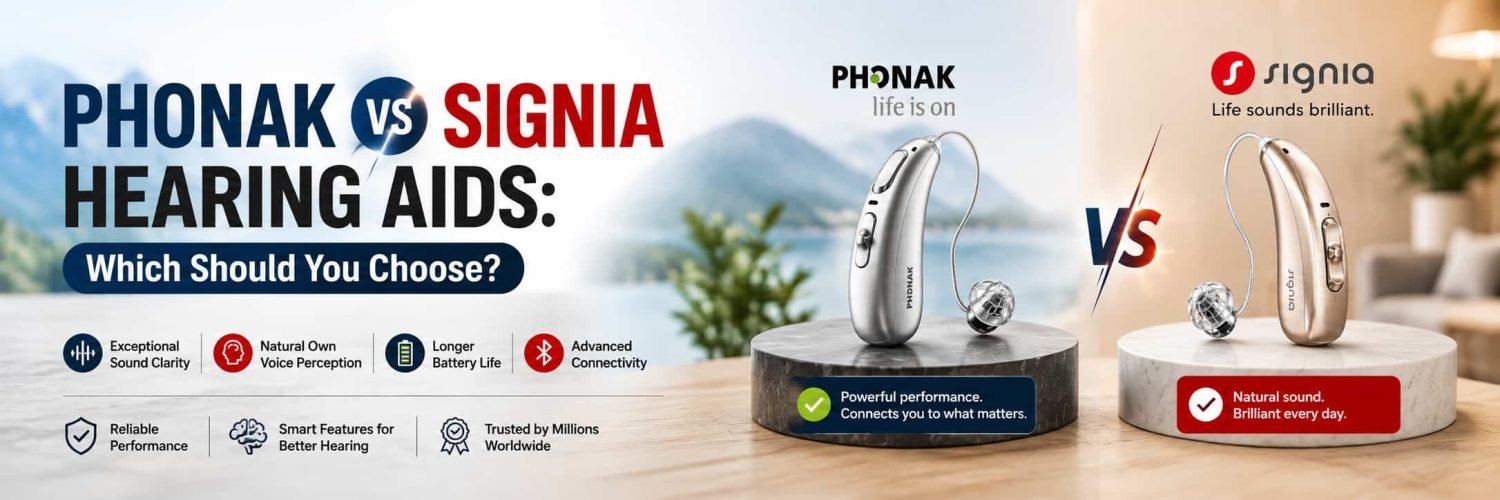
This guide compares Phonak and Signia hearing aids across sound quality, noise handling, connectivity, rechargeable options, comfort, and cost. It explains why the right choice depends on your hearing profile and lifestyle, not brand alone, and why a professional hearing test and proper fitting matter more than any feature list, especially for readers evaluating options in Kolkata.
“Phonak or Signia, which one should I buy?” This is one of the first questions people ask once they decide to look into hearing aids. It makes sense. Both are established names, and comparing two well-known brands feels like a reasonable place to start.
The honest answer is that brand name is only one part of a much bigger decision. Two people with a very similar hearing test result can still need different devices, because their daily environments, communication needs, comfort preferences, and expectations are rarely the same.
Neither Phonak nor Signia is automatically the right choice for everyone. The better option depends on your hearing assessment, your lifestyle, the features you actually need, how comfortable the device feels, and how well it is fitted to you.
Phonak vs Signia at a Glance
The table below gives a general sense of how the two brands approach hearing technology. Exact features differ from model to model within each brand, so treat this as a starting point for discussion with a hearing care professional, not a final verdict.
| Factor | PhonakSonova | SigniaWS Audiology |
|---|---|---|
| Hearing technology | AutoSense OS adapts automatically to sound scenes; flagship models add a dedicated AI chip for noise separation | Integrated Xperience (IX) platform with a cloud-connected AI assistant and multi-stream processing for group conversation |
| Hearing in noise | Strong automatic scene adaptation; flagship Sphere / Infinio models are built for speech clarity in loud places | RealTime Conversation Enhancement designed to help follow several speakers at once in busy settings |
| Rechargeable options | Available across most current RIC, BTE and custom models; runtime varies by model | Available across most current RIC, BTE and custom models, including a completely-in-canal option |
| Smartphone connectivity | Bluetooth streaming and hands-free calling on newer models; compatibility depends on the exact model and phone | Bluetooth streaming and hands-free calling on newer models; compatibility depends on the exact model and phone |
| Hearing-aid styles | Behind-the-ear, receiver-in-canal and custom in-ear options, varying by model line | Behind-the-ear, receiver-in-canal, ultra-slim and completely-in-canal options, varying by model line |
| Personalisation | Fitted and fine-tuned by a hearing care professional using your audiogram and feedback | Fitted and fine-tuned by a hearing care professional using your audiogram and feedback |
| Best suited for | Depends on your specific model, hearing profile and environment, not the brand alone | Depends on your specific model, hearing profile and environment, not the brand alone |
| Professional fitting | Essential for performance and comfort | Essential for performance and comfort |
What Is the Difference Between Phonak and Signia?
Phonak, part of the Sonova group, is known for hearing aids built around automatic sound processing. Its AutoSense system continuously reads the listening environment and adjusts settings without the wearer needing to do anything, and its higher-end Sphere and Infinio models add dedicated onboard AI chips aimed specifically at separating speech from noise.
Signia, part of WS Audiology, has built its recent hearing aids around what it calls the Integrated Xperience platform. A notable feature is a cloud-connected AI assistant and processing designed to help wearers follow more than one speaker in a group conversation, which is a common complaint among hearing aid users.
In practice, comparing individual models within each brand is usually more useful than comparing the brands as a whole. A mid-range Phonak model and a mid-range Signia model may suit a given person better or worse than the flagship version of either brand, depending on that person’s hearing loss and daily routine.
Phonak Hearing Aids: What Should You Know?
Phonak’s current lineup is built around automatic scene detection, meaning the device tries to sense whether you are in a quiet room, a car, a noisy restaurant, or a concert and adjusts accordingly. Its flagship Sphere and Infinio models add a separate AI processor that works specifically on isolating speech in loud, layered noise, which independent hearing aid labs have rated well for that specific task.
Rechargeable options are available across most current Phonak product lines, along with a range of styles, including behind-the-ear, receiver-in-canal, and custom in-the-ear devices. Bluetooth connectivity, hands-free calling, and app control through myPhonak are available on newer models, though exact compatibility depends on your phone and the specific hearing aid.
Phonak does not suit every hearing profile equally well. The right model still depends on the degree and type of hearing loss and on whether the extra processing power of a top-tier model is actually needed for your daily life.
Signia Hearing Aids: What Should You Know?
Signia’s Integrated Xperience devices are designed around understanding group conversation, using what the company calls RealTime Conversation Enhancement to help the wearer track multiple speakers rather than just the loudest one. Signia also offers Own Voice Processing, intended to make a wearer’s own voice sound more natural through the hearing aid, something many new users find takes getting used to.
Rechargeable Signia hearing aids span several styles, from behind-the-ear and receiver-in-canal models to an ultra-slim design and a completely-in-canal option that sits almost invisibly in the ear. As with Phonak, Bluetooth streaming, hands-free calling and app support are available on newer devices, and compatibility should always be confirmed for your specific phone.
Signia’s technology tends to appeal to people who spend a lot of time in group settings, but as with any brand, results depend heavily on correct fitting and on matching the model to the individual’s hearing needs.
Which Is Better for Hearing in Noisy Places?
Restaurants, family gatherings, busy streets, meetings, and other crowded spaces are where most people notice the limits of their hearing. Both Phonak and Signia have invested heavily in noise management, but neither can promise effortless, perfect speech understanding in every noisy setting.
How well a hearing aid performs in noise depends on several things together: your specific hearing profile, the model’s noise-management technology, how well the microphones are positioned for your ear, how the device has been programmed, and how much time you have spent adapting to it. A well-fitted mid-range device often outperforms a high-end model that has not been fitted or programmed correctly.
If challenging listening environments are a major part of your daily life, mention this clearly during your hearing assessment so your audiologist can factor it into the recommendation.
Rechargeable Options and Smartphone Connectivity
Rechargeable hearing aids have become the norm rather than the exception on both brands’ current model ranges, and they appeal particularly to older adults, people who find changing small batteries fiddly, and frequent travellers who want a simple end-of-day routine. Battery life and charging speed vary by specific model, so ask your provider for figures on the exact device you are considering rather than assuming a general number.
Both Phonak and Signia offer smartphone streaming and hands-free calling on their newer devices, but no hearing aid works identically with every phone. Compatibility depends on the specific model, your phone’s make and operating system, and any accessories involved. Always confirm compatibility with your own device before deciding.
Which Hearing Aid Is More Comfortable?
Comfort is one of the most personal parts of this decision, and it cannot really be judged from a brochure or a website. Behind-the-ear designs, receiver-in-canal designs, and custom in-the-ear designs each sit differently in the ear, and the right choice depends on your ear shape, the degree of your hearing loss, and how the device stays in place through the day.
A hearing aid that looks impressive on paper is not the right choice if it feels uncomfortable, causes irritation, or keeps slipping out of place. This is one of the strongest reasons to try a device before committing to it, rather than choosing based on specifications alone.
Phonak vs Signia: Which Is Better for Older Adults?
For older adults, ease of daily use often matters more than the length of a feature list. Simple controls, reliable rechargeability, a comfortable fit, and dependable follow-up support from a clinic tend to matter more day to day than advanced smartphone features that may go unused.
Family involvement also helps. Relatives who understand how the device works, how it is charged, and when to bring it in for adjustment can make a real difference to how consistently an older person actually wears their hearing aid. Not every older adult has the same needs, so this is worth discussing openly during the consultation rather than assuming.
Does the Hearing Test Matter More Than the Brand?
Yes, and this is worth understanding clearly before comparing brands any further. A hearing assessment, which may include audiometry and speech-related testing, is what determines the degree and type of hearing loss, whether both ears are affected equally, and how well you understand speech in different conditions.
This information, not the brand name on the device, is what actually guides which technology level and which features are appropriate for you. Happy Ears provides audiological services, including audiometry and speech-related hearing tests as part of this process. This article is intended for general education and is not a diagnosis; a qualified hearing care professional should assess your individual hearing before any device is recommended.
How Much Do Phonak and Signia Hearing Aids Cost?
There is no single, universal price for a Phonak or a Signia hearing aid. Cost depends on the specific model, its technology level, the hearing-aid style, included features, the fitting and programming process, any accessories, and the after-sales support that comes with it.
Rather than looking for the cheapest option or assuming a higher price always means a better fit, ask your provider for a clear breakdown of what is included in any quoted price, including follow-up visits, adjustments and maintenance.
Should You Choose Phonak or Signia?
Phonak may be worth considering if a specific model within its range matches your hearing loss, your preferred connectivity, your comfort expectations and the environments you spend most time in.
Signia may be worth considering if a specific model provides the combination of sound processing, design, connectivity and comfort that suits your daily routine, particularly if group conversations are a common challenge for you.
The more useful question is not “Phonak or Signia” but “which specific device, from either brand, is appropriate for my hearing profile.” That question can only be answered properly after a hearing assessment.
Why Professional Fitting Matters
Buying a hearing aid is not like buying an ordinary electronic gadget. The process involves a hearing assessment, device selection based on that assessment, an initial fitting, careful programming to your specific hearing loss, adjustment based on your feedback, and ongoing follow-up as your ears and needs change.
Happy Ears offers hearing-aid fitting, digital programming, counselling and maintenance-related services as part of this process. Even the most advanced Phonak or Signia device will underperform if it has not been fitted and programmed correctly for the person wearing it.
Questions to Ask Before Buying a Hearing Aid
- What type and degree of hearing loss do I have?
- Which hearing-aid style would suit me and my lifestyle?
- Which environments do I most need to hear clearly in?
- Do I need a rechargeable hearing aid?
- Will the device work reliably with my phone?
- What maintenance will the device need over time?
- How many follow-up adjustments are usually recommended?
- Can I try the device before I decide?
- What exactly is included in the quoted price?
- What happens if the device does not feel comfortable after fitting?
Points to Ponder Before Choosing Phonak or Signia
A few points are worth keeping in mind as you make this decision. Avoid choosing based only on brand popularity or on price. Avoid assuming that the most advanced, most expensive model is automatically the right one for you. Get your hearing evaluated properly, compare the specific models that suit your hearing profile, think honestly about your daily listening environments, and ask about fitting, trial options and follow-up support before you commit.
The best hearing aid is not necessarily the one with the longest feature list. It is the one that suits your hearing needs, fits comfortably, performs well in the situations that matter most to you, and is properly adjusted and supported over time.
If you are trying to decide between Phonak and Signia, the first practical step is a hearing assessment. A professional evaluation and a hearing-aid trial, available at Happy Ears in Kolkata, can help you compare suitable options based on your hearing profile, comfort, lifestyle and daily listening needs, without pressure to decide before you are ready.


