

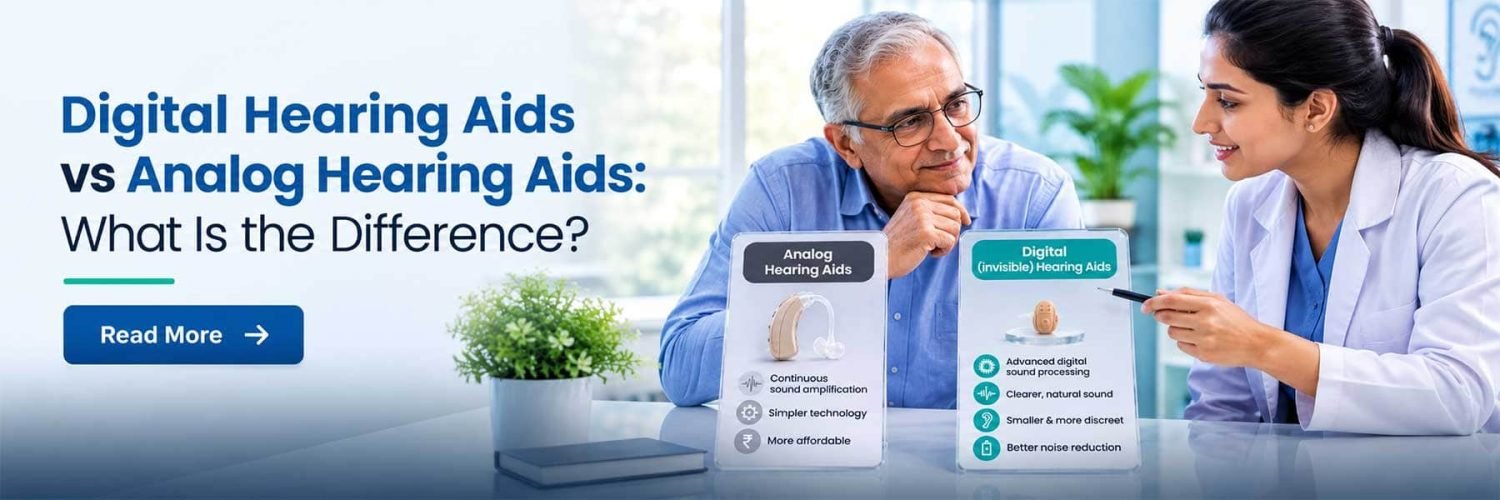
Ask someone who’s shopped for a hearing aid recently what confused them most, and “digital versus analog” usually comes up early. The terms get tossed around as if everyone already knows what they mean, but the difference is fairly simple once someone walks you through it.
Both kinds of hearing aids do the same basic job: take in sound and make it louder. Where they part ways is how they get there. An analog hearing aid boosts the incoming sound wave pretty much as it arrives. A digital hearing aid turns that sound into digital information first, then runs it through a small onboard processor that decides how loud and in what way to deliver it to your ear.
That extra processing step is really the whole story. It’s why digital hearing aids can be fine-tuned with far more precision than analog ones and why they’ve become the default option in most of the world. Market research puts digital hearing aids’ share of global hearing aid revenue somewhere between the high 80s and low 90s in percentage terms, with analog devices hanging on mostly in lower-cost markets. That doesn’t mean digital automatically wins for every person, though. The technology only earns its keep when it’s matched to your actual hearing loss and fitted properly, which is really what this comes down to.
How an Analog Hearing Aid Actually Works
Picture an old radio amplifier, and you’re most of the way there. An analog hearing aid picks up sound through a microphone, turns it into an electrical signal, and pushes that signal through an amplifier before sending it out through a speaker. The NIDCD describes this same layout, a microphone, amplifier, and speaker, as the backbone of every hearing aid, analog or digital.
The signal in an analog device stays in continuous wave form the entire time. Some older analog aids simply amplify everything and can’t be adjusted. Others, called analog or programmable aids, include a small chip that lets an audiologist set a couple of programs, one for a quiet room and another for a crowded restaurant. Even those work within a narrower band of adjustment than a digital chip allows. In practice, analog hearing aids turn everything up together. Speech gets louder, but so does the hum of the refrigerator and the chatter three tables over.
How a Digital Hearing Aid Works
A digital hearing aid starts the same way; sound comes in through a microphone but then takes an extra step. The sound gets converted into a digital signal, essentially a stream of numbers, similar to how a photo becomes a file on your phone. A processor inside studies that stream in real time across dozens of frequency bands, deciding how much to boost each one before turning the signal back into sound.
Worth clearing up early: digital doesn’t mean louder. A digital hearing aid isn’t inherently more powerful than an analog one sitting next to it. What it offers is finer control, the ability to push up frequencies where your hearing has faded while leaving the ones that still work fine alone, and to keep adjusting that balance automatically as your surroundings change.
Where the Two Technologies Really Differ
Here’s a side-by-side look. Not every digital device on the market includes every feature below; how much a device can do depends heavily on its price point and manufacturer.
| Feature | Analog Hearing Aids | Digital Hearing Aids |
|---|---|---|
| Sound processing | Continuous signal, amplified directly | Converted to data, processed by a chip |
| Amplification | Broad, uniform | Frequency specific, programmable |
| Customization | Limited; a few presets on some models | Generally greater, fine tuned by an audiologist |
| Noise management | Limited | More sophisticated processing available |
| Feedback management | Limited | Advanced cancellation is common |
| Connectivity | Generally limited or none | Many models offer wireless connectivity |
| Availability | Niche, less common today | The predominant technology today |
| Cost | Historically lower for basic devices | Wide range depending on features and tier |
Sound Quality Isn’t Guaranteed by Technology Alone
A lot of people assume digital automatically sounds better, and often it does, but not for everyone. What you hear depends on more than the chip inside your hearing aid: how severe your hearing loss is, how carefully the device was programmed, the physical fit, the room you’re in, and your own expectations. Two people wearing the same digital model can walk away with different opinions of it, simply because one got a better fitting.
Noise, Feedback, and the Limits of What Processing Can Fix
Many digital hearing aids include tools built for noisy rooms: noise reduction that quiets steady background sounds, directional microphones that lean toward whatever’s in front of you, speech enhancement tuned to frequencies human voices occupy, and automatic settings that shift depending on your surroundings. These genuinely help in a lot of situations, but they don’t make noise vanish, and nobody should expect a device that filters out a crowded restaurant the way healthy ears once did.
Feedback, that sharp whistle a hearing aid sometimes makes, happens when sound leaving the speaker gets picked back up by the microphone and loops. Analog devices have fairly limited ways of dealing with this. Most digital aids catch the loop early and cancel it out, often by generating an opposite sound wave the instant feedback starts to build. Still, a digital hearing aid isn’t immune. A loose fit or a plug of earwax causes the same whistle no matter how advanced the chip is.
Customization, Connectivity, and What They Actually Cost
Programming is where digital pulls furthest ahead. An audiologist can adjust amplification frequency by frequency to match your hearing test, save several environment-based programs, and revise settings later as your hearing changes. None of that helps much if the initial fitting was rushed, though. A well-fitted analog device can outperform a poorly programmed digital one, so the professional behind the device matters as much as the device itself.
Many digital hearing aids now offer Bluetooth, smartphone app control, audio streaming, and rechargeable batteries, but not every model has all of it. Entry-level devices skip the extras and focus on core amplification, while premium models bundle in most of the above.
Cost is where things get wide ranging, and it helps to ground this in what buyers actually see in Kolkata. Basic pocket or body worn analog aids, still sold across clinics in areas like Salt Lake, Tollygunge, and Shyambazar, typically run 1,500 to 8,000 rupees. Behind the ear digital models generally start around 15,000 to 40,000 rupees, receiver in canal devices land closer to 30,000 to 60,000 rupees, and premium AI powered or rechargeable devices from brands like Phonak, Signia, Widex, and Oticon can run 1 lakh to 6 lakh rupees or more per ear. A proper hearing test, usually free or low cost at most Kolkata clinics, is worth doing before committing to a price bracket, since guessing at the wrong device type is a common and expensive mistake.
So Which Should You Actually Get?
For most people shopping today, digital is the practical answer, mainly because it’s what almost everything on the market is built around now and because it allows for far more precise adjustment than analog technology. That’s not the same as saying digital fits every situation automatically. What matters more is your specific hearing loss, the environments you spend your time in, your budget, and whether the device gets fitted properly. None of this is medical advice, and a licensed audiologist is genuinely the right person to match a device to your ears, not a product description.
A few things worth thinking through before you buy: how severe your hearing loss actually is, the places where you struggle most, whether wireless features matter to you, how you feel about rechargeable versus disposable batteries, your total budget once fitting and follow up visits are counted, and what warranty or repair support comes with the device.
A Few Myths Worth Retiring
- Digital isn’t automatically better; it’s only as good as the fitting behind it.
- Digital hearing aids reduce noise; they don’t erase it.
- Analog isn’t always cheaper once you compare features and tiers.
- More features don’t help if you don’t need them.
- The device is only half the equation; fitting and wear time matter just as much.
The Bottom Line
Digital technology has become the standard for good reason. It processes sound with a precision analog circuitry that was never built for, and most devices you’ll come across today, budget or premium, reflect that shift. Even so, the right hearing aid for you comes down to your hearing loss, your daily environments, your budget, and how well the device gets fitted, not just whichever word appears on the box. Talk to a qualified audiologist, get properly tested, and let that conversation guide the decision.


