

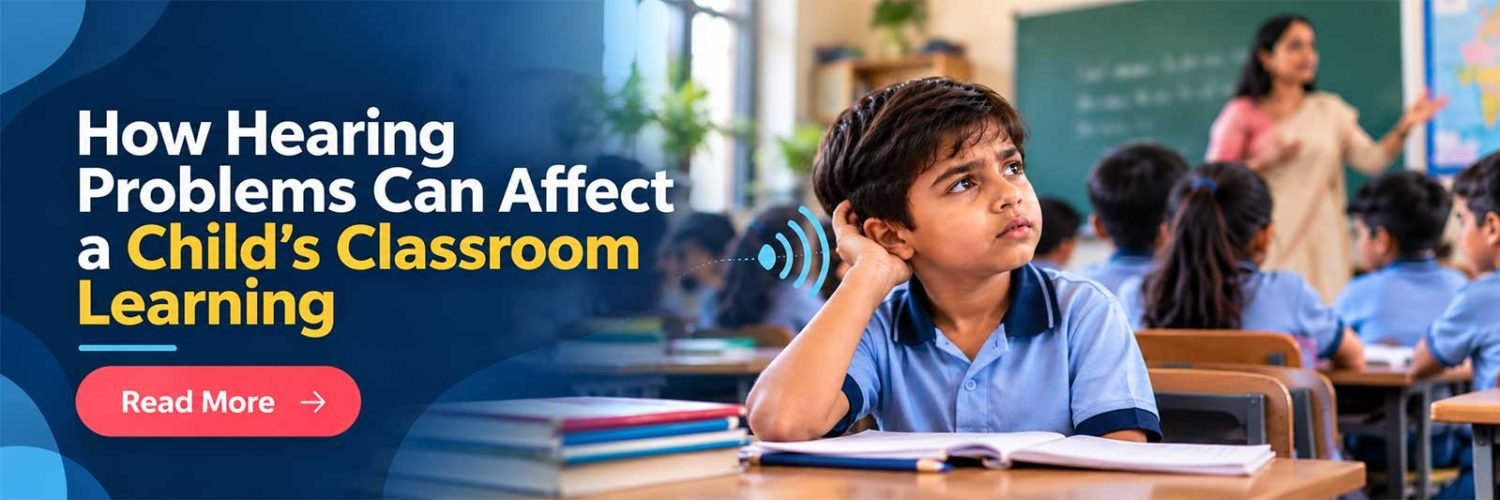
Summary: Children rely on hearing to follow lessons, learn new words and make friends. This guide explains how hearing problems can affect classroom learning, the school signs parents often overlook, why noisy rooms make things harder, and when a children’s hearing test is worth doing. It also covers simple steps parents and teachers can take together.
Why a child who seems inattentive at school may simply not be hearing the lesson clearly
Your child’s teacher says homework is often incomplete and instructions get missed. At home, there is a lot of “What?” and “Pardon?”, and you start wondering whether it is laziness or daydreaming.
Sometimes the cause is quieter. When a child cannot hear every word clearly, school turns into a guessing game. That is where hearing loss and classroom learning meet, and it is easy to miss because the child usually looks perfectly fine.
Here is how hearing difficulties show up in class, which signs matter, and when a test makes sense. For the early-years side, see our article on hearing loss and speech development in children.
Hearing Loss and Classroom Learning: Why Listening Matters
A classroom runs on listening. The teacher explains, children answer, friends whisper, and homework gets announced in the last two minutes before the bell.
Children use their hearing to follow explanations, pick up new words, understand instructions, and join conversations. It also supports reading, because a child who hears speech sounds clearly finds it easier to link them to letters. The American Speech-Language-Hearing Association (ASHA) says exposure to language is critical for learning, communication, and literacy. So when hearing is even slightly off, the effect can reach every subject, not just English or Bengali.
How Hearing Difficulties in the Classroom Show Up Day to Day
Take this: “Open page 42, do questions 3 to 6 and submit tomorrow.” A child who catches only half of it opens the wrong page or skips the homework. The teacher sees carelessness. The child is working with missing information.
Group discussions are harder still. Voices overlap, the speaker keeps changing, and the child is still working out what one classmate said when the next one starts. After a while, many children stop trying and just nod along.
How Hearing Affects Learning, Reading and Vocabulary
Reading begins with sound. A child who hears words a little blurred may mix up similar sounds like “bat” and “pat”, spell words the way they heard them, or pick up new vocabulary more slowly.
This does not mean the child is weak at studies. It may only mean the sounds reached them unclearly. Extra tuition may not fix that. A hearing check can show whether clearer listening is the missing piece.
Participation, Concentration and Friendships
Many children with hearing difficulties go quiet in class. If you are never sure you heard the question properly, raising your hand feels risky. Others avoid asking for a repeat because classmates might laugh.
Concentration takes a hit too. Listening with a hearing difficulty is tiring, and the child strains to fill in the gaps, and by afternoon the energy is gone. ASHA lists tiredness at the end of the school day among the signs of hearing loss in children. A restless, fidgety child at 3 pm may not be misbehaving at all.
Friendships can suffer quietly. Playground chatter is hard to follow, so a child may laugh late at jokes, miss the rules of a game or drift to the edge of the group. It is easy to read that as shyness.
Why Noisy Classrooms Make Hearing Difficulties Worse
A child with typical hearing can usually cope with ceiling fans, scraping benches and chatter from the next room. A child with a hearing difficulty often cannot, because background noise covers the softer parts of speech.
Picture an ordinary school day. The teacher keeps talking while writing on the board, back turned to the class. The child on the last bench sits far from the voice. Three students answer at once. Hard walls and high ceilings make sound bounce around. For a child already missing soft speech, a lesson can turn into a blur.
Signs of Hearing Loss in Children at School
No single sign proves anything, but a pattern is worth noticing. Your child may:
- Ask the teacher to repeat instructions again and again
- Wait and watch classmates before starting an activity
- Say “What?” or “Pardon?” often
- Struggle more when the room is noisy
- Turn one ear towards the speaker
- Find group conversations hard to follow
- Respond inconsistently when spoken to
- Seem very tired after school
- Have unexplained trouble with lessons despite effort
These signs do not automatically mean hearing loss. Vision problems, anxiety, attention difficulties and learning differences can look similar. Temporary causes matter too, such as earwax, a cold or fluid behind the eardrum. ASHA notes that by age 10, around 80 percent of children have had at least one middle ear infection, which can cause temporary hearing loss. That is why a proper assessment works better than guessing at home, and why no child should be labelled based on classroom behaviour alone.
Can Mild Hearing Loss Affect a Child’s Academic Performance?
It can, though not in every child. Mild or one-sided hearing loss does not stop a child from hearing a loud voice up close, so everyone assumes things are fine. But when the room is noisy, or the teacher is far away or turned around, pieces of speech go missing.
Some children cope for years by working harder and guessing from context, so their marks look normal. Others slowly slip. Hearing loss does not mean poor results, and with support children can learn and do well.
How Parents and Teachers Can Support a Child Who Struggles to Hear
For parents: Talk to the class teacher and share what you notice at home. Watch when listening gets worse, for example, in noise, at a distance, or when your child cannot see your face. If the concerns continue, arrange a hearing assessment and follow the advice of qualified professionals.
For teachers: Seat the child near the front, where they can see your face and hear clearly. Face the class while speaking, not the board. Keep unnecessary noise down. Repeat or rephrase important instructions, and write homework on the board, since visual materials help. Then check understanding by asking the child to repeat the instruction.
Support should fit the individual child. A front seat may be enough for one child. Another may need hearing aids or classroom listening devices, which ASHA lists among classroom supports.
When Should You Get a Children’s Hearing Test?
Think about a test if listening problems keep appearing over a few weeks, if a teacher raises concerns, or if your child has had repeated ear infections. There is no need to wait for poor results at exam time.
The first is “she reacts to loud sounds, so her hearing is fine.” A child can hear a door slam and still miss soft speech. The second is “she passed the newborn screening.” That screening checks hearing at birth. ASHA says some mild losses can be missed by it, and hearing loss can also begin later or change over time.
A children’s hearing test is matched to age and is painless. Younger children may do play-based tasks, such as dropping a block in a bucket whenever they hear a beep. Older children usually press a button or raise a hand. A quick hearing screening for children can show whether a full assessment is needed.
Why Early Hearing Assessment Helps
Whatever the result, you get a clearer path. If hearing is typical, you can look at other reasons for learning trouble. If there is a difficulty, an audiologist may suggest an ENT specialist, speech therapy, hearing devices or support at school. ASHA notes that early identification and support are linked to better outcomes for children with hearing loss.
In Kolkata, Happy Ears offers audiometry, speech audiometry, tympanometry and speech therapy under one roof. You can see the full list on the services page.
Frequently Asked Questions About Children’s Hearing and School
Can hearing loss affect a child’s school performance?
Yes, it can. Missed instructions, tiring listening and slower vocabulary growth all play a part, though not every child is affected equally.
Can a child have hearing loss and still respond to normal conversation?
Yes. Many children hear loud or close voices well and still miss soft speech, especially in noise.
Why does my child struggle to hear the teacher in class?
Noise, distance, echo and a teacher facing away can all play a part. A hearing difficulty or an ear infection may be involved too, so a test helps.
Can mild hearing loss affect classroom learning?
It can. Even mild or one-sided loss may cause missed words when the room is noisy.
What are the signs of hearing problems in school children?
Frequent repeats, saying “What?” watching others before starting, trouble in noise, and tiredness after school. A professional check confirms the cause.
Should children have regular hearing tests?
Hearing can change over time, so regular checks make sense, especially after ear infections. Ask your audiologist how often suits your child.
Can hearing difficulties affect a child’s concentration?
Yes. Straining to listen is tiring and can look like inattention, so rule out hearing before assuming a child is not trying.
Helping Your Child Hear, Learn and Participate With Confidence
Hearing loss and classroom learning are closely linked, but the problem is often manageable once someone notices it. A child who says “What?” a lot, tires easily after school or falls behind without a clear reason deserves a proper check, not a scolding.
If these signs keep showing up, trust your instincts. If you are in Kolkata, contact Happy Ears to book a children’s hearing assessment, and our audiologists will explain the results in plain language.


